
Investing in Data Centres: Six Markets, One Missing Line
European Data Centres, Read from the Gulf · Part Seven of Seven
Written by Lanre Okunnuga, September 2026
This series opened with a five-line checklist for an allocator underwriting a data centre: offtake quality, connection certainty, regulatory durability, transmission reality, demand portability. Six markets later, a sixth line belongs on it: who can actually write the cheque, and what that cheque buys once it is written.
Five regulators, one market pair without a published regime, and four capital names recur across this series. Here is who they are.
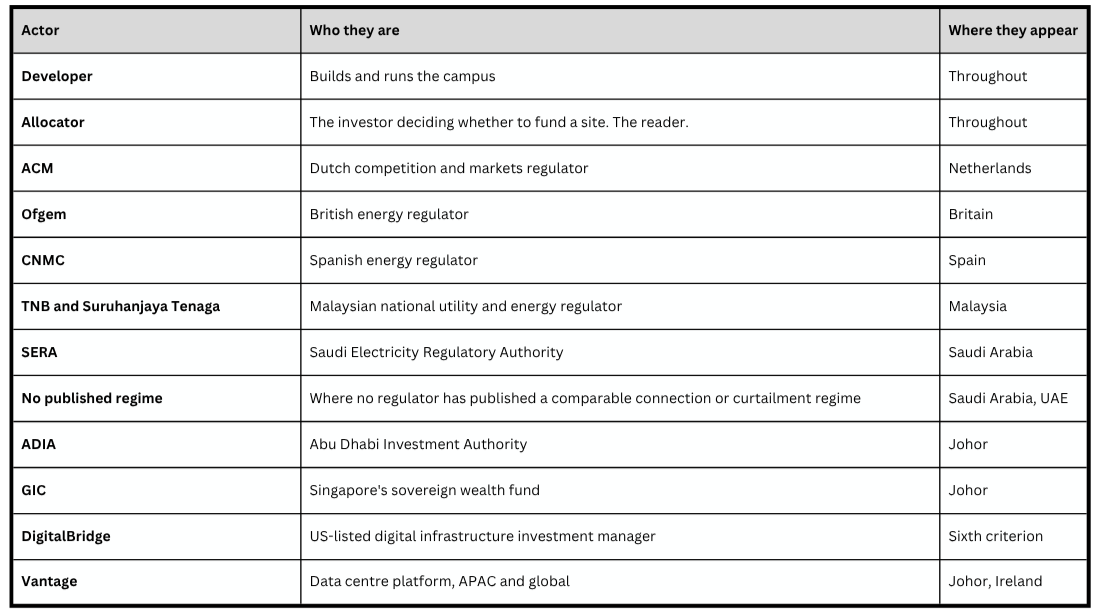
One word per role, held for the rest of the piece. Firmness and flexibility describe the same thing in this series; only firmness is used from here.
Each of the first five criteria carries one governing fact.
Offtake quality, from Piece 2. The contract decides whether a facility's earning power is locked to one generation of silicon, not the hardware itself. A training contract reserves capacity for the life of the agreement. An inference contract pays for availability, and the operator can refresh the chips underneath it without losing the tenant.
Connection certainty, from Piece 3. An Bord Pleanála refused Vantage's Dublin campus, case ABP-317446-23, on a ground stated explicitly in the decision: the absence of a fixed grid connection agreement. Until that agreement exists, a campus remains a planning application.
Regulatory durability, from Piece 4. Germany's renewables mandate for data centres has already softened once. A 2027 deadline for 100 percent renewable supply moved to 2030 in June 2026, and a waste-heat requirement was dropped in the same revision. A rule written in one parliament does not bind the next.
Transmission reality, from Piece 5. Dutch and Spanish regulators built their mechanisms independently and arrived at the same answer. TenneT discounts a connection in exchange for interruptibility. The CNMC grants a connection that reserves the right to interrupt it. Both are pricing the same scarce thing, from opposite ends.
Demand portability, from Piece 6. Johor inverts the table the other five markets built. TNB names data centres as a driver of its transmission programme. The Saudi Electricity Company's programme, covered in Piece 5, never named them at all.
The sixth criterion is the one this series has been assembling without naming. State the scale first. The Abu Dhabi Investment Authority manages assets estimated between USD 850 billion and USD 990 billion. The Public Investment Fund reports roughly USD 1.21 trillion. The five largest Gulf sovereign funds together hold somewhere between USD 3.5 trillion and USD 3.7 trillion.
Set that beside Johor, corrected from how this series first reported the Vantage APAC commitment. Ahead of Piece 6, the USD 1.6 billion commitment into Vantage's APAC platform read as an ADIA transaction. GIC and ADIA in fact led it jointly, on 11 September 2025, and neither institution's announcement names a proportion between them. Vantage's closing statement, 24 November 2025, confirms only that part of that combined commitment funded the acquisition of Yondr's Sedenak campus, JHB1. ADIA's presence in Johor is real and asset-level, and it came as one share of a joint commitment.
Now the absence. No family office anywhere in these six markets holds a disclosed direct position in a data centre asset, at any ticket size. The closest match this series found is EUR 50 million of convertible credit into an Irish developer, and credit into a developer is a different instrument from equity in a live facility. It is labelled as such and it does not count as the missing case.
Below sovereign scale, one documented route exists. A feeder distributed through Citi Private Bank carries a minimum investment of USD 1 million into DigitalBridge Partners III. That strategy closed in November 2025 at USD 7.2 billion in fund commitments. A further USD 4.5 billion in co-investment capacity brought the total strategy to USD 11.7 billion.
That difference is the finding. No rule bars a smaller allocator from this sector. A campus costs hundreds of millions to low billions to build, so a ticket sized at EUR 20 million to EUR 100 million cannot buy a meaningful share of one and still carry a say in how it is run. The fund is the only documented route underneath sovereign scale, and a fund position is pooled by construction. A holder of that position cannot point to a named asset and claim a specific share of it. ADIA can point to JHB1, because a commitment large enough to be allocated to one acquisition leaves a public trace behind it.
Scale, in this sector, buys attribution before it buys anything else.
Four times now, this series has found more than one published figure for a single quantity, and found them in disagreement.
Piece 2 found four different figures for Saudi Arabia's operational data centre capacity. Piece 5 found four different envelopes for one Saudi transmission programme, ranging from SAR 220 billion to SAR 472 billion depending on which source and which period were counted. Piece 6 found Johor's live capacity reported between 850 and 1,110 megawatts, and its pipeline reported between 2.5 and 8.5 gigawatts, across five separate sources.
The fourth instance did not require a second source at all. Ofgem's Call for Input, published 13 February 2026, put data centres at roughly 50 gigawatts of Britain's connections queue. Ofgem's consultation, published 29 July 2026, stated that “approximately 73 GW of the total demand queue are data centres, comprising around 315 data centre projects.” Five months separate the two documents, and one regulator wrote both. The difference comes from the filters. February counted facilities likely to receive a ready-to-connect offer. July counted the full data centre share of the demand queue. Different filters, applied by the same institution, produced a 23 gigawatt swing.
An allocator reading a single figure in this sector is reading one cut of a number that moves depending on who is counting and what they chose to include. The screening question that follows from four instances is simple: how many sources give this figure, and what is the range between them.
Piece 5 found that Dutch and Spanish regulators, working independently, both landed on the same instrument. A customer willing to accept interruption pays less for a connection than one who insists on firmness. Tested against the Gulf, no equivalent was found.
Saudi Arabia's electricity regulator prices connections by the size of the load, in three bands, and does not price how firm that load promises to be. A 2006-07 industrial time-of-use trial shaved several megawatts off peak demand across a small group of customers and was never developed into a live product. Recent modelling estimates that data centres alone could contribute close to a gigawatt or more of demand-response potential by 2030, but a model of what could be bid is not a tariff a developer can buy today. No comparable product surfaced in the UAE or elsewhere in the Gulf either.
The price on firmness in Piece 5 is a European answer to European scarcity. The Gulf has not needed that answer yet, because it is still selling energy cheaply and rationing connections by size rather than by how interruptible a customer is willing to be. That is a market condition, and the European pattern cannot be assumed to travel to it.
Water entered this series through Johor, where a 1962 agreement commits the state to supply its neighbour water until 2061 even as its own regulators restrict new water-intensive capacity. Tested against the Gulf, the picture looks different.
Forecasts exist and gates do not. The UAE's AI sector is projected to consume roughly 61 billion litres of water annually by 2030. Gulf-wide data centre water demand is projected near 426 billion litres by the same year. Roughly 60 percent of a facility's water footprint sits inside its electricity generation rather than inside its cooling system, which ties the water question to how power is produced rather than to how a hall is cooled.
What has followed those forecasts is engineering rather than policy. Operators report that liquid cooling can cut water use sharply against air-based systems. NEOM's redesign has been reported to favour coastal sites partly for access to seawater cooling. No named Gulf project has been refused, delayed or redesigned on water grounds in anything this research located, and no Gulf regulator publishes anything resembling Johor's intensity ban or its approved-against-actual consumption reporting. NEOM's cancellation of a planned desalination plant sits in the same reporting period, and no document connects that cancellation to a data centre decision, so the two facts stay apart here as well.
Water in the Gulf, on the present record, is a cost and an engineering variable rather than a published constraint. Piece 6's water rule stays a Johor-specific finding rather than becoming a seventh line for every market in this series.
Four postures toward disclosure have appeared across six markets, and no market has adopted more than one.
The Netherlands and Britain publish a queue: request counts, gigawatt totals, in the Dutch case a breakdown by sub-grid. Spain publishes curtailment by location: a paid settlement market, an unpaid residual sitting outside it, and node-level modelling that shows a national percentage means little at any single site. Malaysia publishes neither a queue nor a curtailment series. It publishes a delivery count instead, projects connected under its fast-track pathway, with no waiting list disclosed behind that pathway. Saudi Arabia and the UAE publish none of the three.
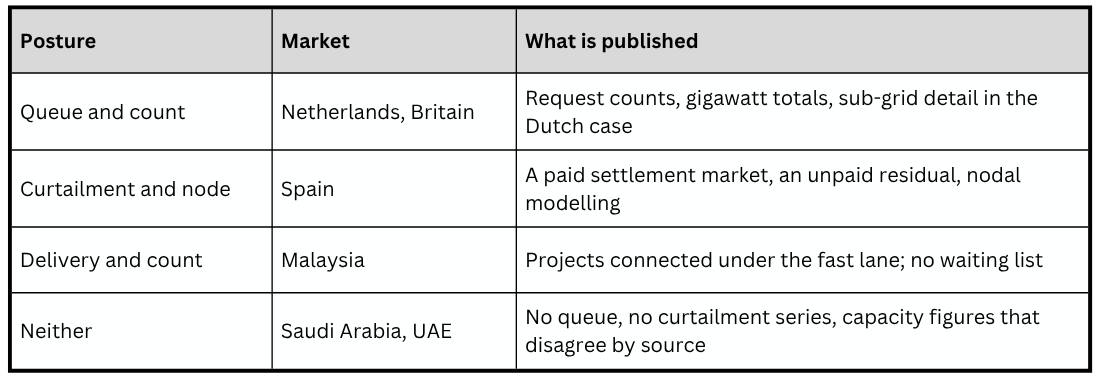
Malaysia's posture is a third form, and the Gulf's is a fourth.
Sources
Sovereign scale
• ADIA assets under management, estimated USD 850 billion to USD 990 billion (sovereign wealth fund trackers, 2026 estimates; ADIA does not publish a figure)
• Public Investment Fund, approximately USD 1.21 trillion reported for 2025
• Combined GCC sovereign fund assets, approximately USD 3.5 trillion to USD 3.7 trillion
The Johor transaction
• GIC Newsroom, 11 September 2025 (investment led by an affiliate of GIC and a wholly owned subsidiary of ADIA; both existing Vantage investors; no proportions disclosed)
• Vantage Data Centers closing statement, 24 November 2025 (part of the capital allocated to close the Yondr JHB1 acquisition)
• AGBI, 11 September 2025; MergerLinks, September and November 2025
• Note: a third “global institutional investor” appears in some September 2025 press recaps and does not appear in either GIC's or Vantage's statements
The fund route below sovereign scale
• Citi Private Bank Key Information Document, Digital Infrastructure III Offshore Feeder, accurate as of 13 April 2023 (minimum investment USD 1,000,000; GP may accept less)
• DigitalBridge Partners III final close, November 2025 (USD 7.2 billion fund; USD 4.5 billion LP co-investment; USD 11.7 billion total strategy), via DigitalBridge, DCD and Telecompaper
• Stoneweg / SERT investment into AiOnX, Q1 2026 (EUR 50 million seven-year mandatory convertible; credit into an Irish developer, not equity in a live facility)
• Blackstone, KKR and Stonepeak flagship minimums for data centre strategies: not found in a single published document
The counting problem
• Ofgem, Call for Input on Demand Connections Reform, 13 February 2026 (approximately 140 facilities, 50 GW; NESO cut tied to likely Gate 2 offers)
• Ofgem, Curate consultation, 29 July 2026, paragraph 2.8 (approximately 73 GW of the total demand queue are data centres; approximately 315 projects; GB peak demand in 2025 approximately 45 GW)
• Piece 2 (four figures for Saudi operational capacity); Piece 5 (four envelopes for one Saudi transmission programme, SAR 220 billion to SAR 472 billion); Piece 6 (Johor live capacity 850 to 1,110 MW; pipeline 2.5 to 8.5 GW)
Firmness in the Gulf
• SERA, Electricity Service Guide (connection rules by coincident demand: 4 MVA or below, 4 to 25 MVA, above 25 MVA)
• KAPSARC DP-00535, 2026 (industrial demand-response potential; data centres 0.9 to 3.8 GW gross by 2030; a model of potential, not a filed product)
• KAPSARC DP-00503 (cloud tariff 18 halalah/kWh; industrial 20 halalah/kWh)
• SEC industrial time-of-use trial, 2006-07, via KAPSARC citing Mahmoud et al. 2010
• Greenberg Traurig, 5 January 2026, on Saudi data centre regulation
• UAE and other GCC interruptible connection products: not found
Water in the Gulf
• Middle East Council on Global Affairs, cited by The National, 22 August 2026 (UAE AI sector water demand approximately 61 billion litres per year by 2030)
• Computer Weekly, March 2026, cited in DCW Middle East (GCC data centre water demand approximately 426 billion litres per year by 2030; approximately 60% of a facility's water footprint sits in electricity generation)
• Khazna, DataVolt and Alfanar public statements on liquid cooling water reduction
• Financial Times, 25 January 2026, on NEOM redesign and coastal siting for seawater cooling
• Named Gulf project refused, delayed or redesigned on water grounds: not found
• Johor-style water-intensity ban or approved-against-actual reporting in Saudi Arabia or the UAE: not found
• NEOM Moonlight desalination plant cancellation, April 2026: reported within the wider NEOM scope review; no document ties the cancellation to a data centre water decision
Publication postures
• Netherlands: ACM prioritisation framework and TenneT congestion publications (Piece 5)
• Britain: Ofgem Call for Input and Curate consultation, as above
• Spain: Operating Procedure 3.2 settlement; Royal Decree 413/2014 article 6.2; Aurora Energy Research nodal modelling (Piece 5)
• Malaysia: TNB Green Lane Pathway delivery counts (Piece 6)
• Saudi Arabia and UAE: no queue register, no curtailment series
Excluded
• A single-source account of Gulf family office allocation patterns was reviewed and excluded. It could be neither corroborated nor falsified, so nothing in this piece depends on it.