
Investing In Data Centres: Water Runs to Singapore Until 2061
European Data Centres, Read from the Gulf · Part Six of Seven
Written by Lanre Okunnuga, September 2026
Tenaga Nasional names data centres as a reason it is rebuilding the Malaysian grid. The Saudi Electricity Company, whose transmission programme Piece 5 examined, never named them at all.
Malaysia went further than naming them. In August 2023 the utility launched a pathway that cuts the grid connection time for a large data centre from 36 to 48 months down to roughly 12. Five European markets in this series ration that load at the gate or after it. Malaysia built a lane that shortens the wait.
Johor is where that lane gets used. The state sits on the Singapore border. A campus there can serve the same customers as one across the strait. Land is cheaper. The state landlord is selling into the cluster. Parks have gone up at Sedenak, Kulai, Iskandar Puteri and Kempas. The developers arriving have found a grid operator willing to connect them fast.
Nine institutions appear in what follows.
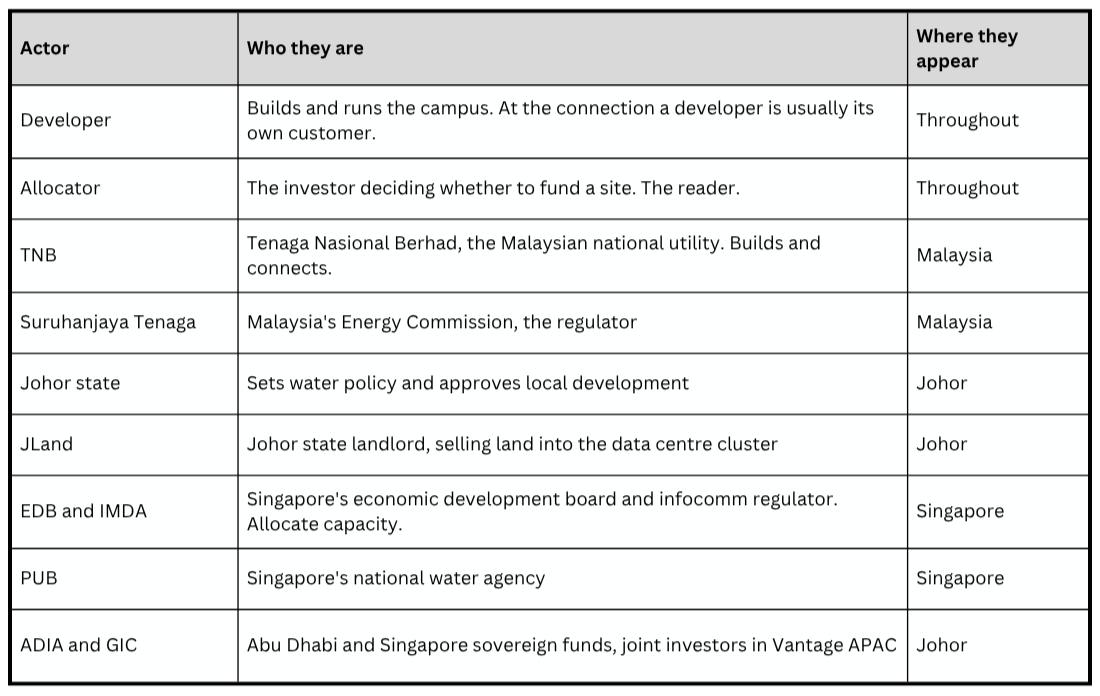
The word operator in this piece means a grid or water utility. A company running a data centre is a developer.
TNB announced the Green Lane Pathway on 8 August 2023, for data centres connecting at 132 or 275 kilovolts. The utility promised connection roughly three times faster than the standard route, and a single point of contact for investors. Five customers were named at launch.
By March 2026 the pathway had delivered 33 projects, according to TNB's chief grid officer speaking at an industry expo the following May. The utility runs a cluster-based grid strategy. Johor is one of the named active clusters.
Capital sits behind that lane. TNB's regulated capital expenditure for the current period runs to roughly RM 43 billion, more than double the previous period. A broker note attributes the increase to the Green Lane Pathway. The programme is described as supporting 7,500 megawatts of new demand.
Malaysia publishes no connection queue of the kind the Netherlands and Britain publish. No request count. No gigawatt total. No waiting list. Malaysia publishes a delivery count: projects connected under a fast lane. Nothing in that count shows what still sits behind them.
The pathway settles a timeline and leaves two questions open. Who pays for upstream network reinforcement does not appear as a posted schedule in TNB's public documents. A published connection charge does not appear either. The series has carried both questions since Piece 3. Malaysia answers neither. Malaysia also offers no interruptible connection product of the kind Dutch and Spanish regulators built. The Green Lane sells speed.
Tariffs moved on 1 July 2025. Suruhanjaya Tenaga introduced a new structure for the current regulatory period. Data centres now sit in an ultra-high-voltage time-of-use class. Separate network and retail charges sit on top of energy. One policy analysis of a worked example puts the resulting bill roughly 10 percent above the old medium-voltage arrangement. Network charges drive that increase. A corporate renewable supply scheme also lets a developer contract directly with a renewable generator across the grid and pay TNB a system access charge for the transport. Announced projects under that scheme reached roughly 4 gigawatts by March 2026.
Johor's constraint arrived at the water tap.
In late November 2025 the state stopped approving data centres in its two most water-intensive tiers. The state executive councillor for housing and local government announced the halt. Facilities running 24-hour water cooling and seeking expansion were told to wait roughly 18 months, to around mid-2027, for water supply approval. Industrial and high-volume water tariffs rose from August 2025. The state is assembling alternative supply in parallel. That supply includes treated effluent from more than a dozen plants and a reverse-osmosis facility with room to expand.
One number in the coverage needs a caution. Industry commentary has flagged a widely repeated figure of 675 million cubic metres for Johor data centre water consumption as a probable unit-conversion error. The more defensible order of magnitude puts a 100 megawatt facility at roughly 4 to 6 million litres a day. Johor's published capacity figures disagree in the same way. That disagreement is recorded below.
The rationing also runs ahead of measured use. Malaysian government figures reported in early 2026 show actual water and power consumption at data centres running near half of what has been approved. Officials read that difference as headroom. Johor is restricting new water-intensive capacity. Its own data still shows consumption well below approvals.
Underneath those measures sits an agreement signed on 29 September 1962 and guaranteed by the separation of the two countries three years later. It expires in 2061. Singapore may draw 250 million gallons a day of raw water from the Johor River, at a price never revised since. Johor is entitled to treated water back, up to 2 percent of that volume.
Johor is adding data centre load on the same river system. The 1962 agreement still sends raw water across the strait for another 35 years.
Johor's own capacity figures do not agree with each other. This is the third market in the series where published numbers for the same quantity fan out.
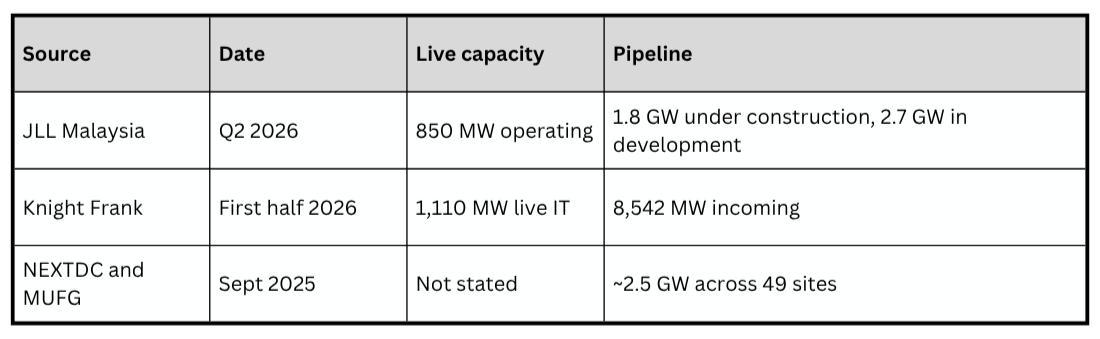
Live capacity runs between 850 and 1,110 megawatts depending on the source. Pipeline runs between 2.5 and 8.5 gigawatts. One operator's plan for a single campus at Kulai doubled from 600 megawatts to 1.2 gigawatts inside a year. That plan is still a plan.
Piece 2 found four figures for Saudi operational capacity. Piece 5 found four envelopes for one Saudi transmission programme. Johor is the third case. Here the dispersion is a multiple.
The neighbour has started building again, on conditions.
Singapore paused new data centre construction in 2019. A pilot call reopened it and awarded 80 megawatts to four parties in July 2023. On 21 August 2026 a second call closed and allocated 200 megawatts, split evenly between four operators. Every awarded project sits on Jurong Island. Each must draw more than half its new capacity from eligible green pathways. Singapore's regulators expect to review a further call within 18 to 24 months.
Existing Singapore stock runs above 1.4 gigawatts across more than 70 facilities. Vacancy there sits near 4.9 percent. Johor vacancy sits near 0.7 percent. A low-carbon park announced on Jurong Island in October 2025 carries long-term headroom of up to 700 megawatts. That figure is park capacity, not allocated capacity. The 200 megawatts already awarded sits inside it.
Two build programmes are running on either side of the strait. I have not found a public source that states what share of Johor capacity serves Singapore demand rather than Malaysian demand. This piece states the two programmes and stops there.
Gulf capital reaches Johor through one disclosed route.
GIC and ADIA jointly led a USD 1.6 billion investment into Vantage's Asia-Pacific platform, announced on 11 September 2025. Neither institution's own statement discloses a split between them. Vantage confirmed on 24 November 2025 that part of that combined commitment funded its acquisition of the Sedenak campus previously developed by Yondr. The site is more than 300 megawatts across roughly 73 acres. Its first phase had already been leased to Oracle.
Piece 3 established ADIA's exposure at platform level. This is the first point in the series where a Gulf sovereign's capital reaches a named asset in a named market.
Beyond that transaction, no other Gulf sovereign or family office position in Johor appears in any public filing. ADIA has not published a separate note on why Johor. Oracle is the named tenant on a campus funded by Gulf and Singaporean capital.
Three published developments could change the trade. Malaysian federal policy was reported in February 2026 to restrict approvals for new data centres that are not AI-focused. The underlying instrument has not been pinned to a gazette, so this piece treats that report as a report. Johor's water rules could tighten further, or run past the current deferral. Singapore's third call, together with the Jurong Island park behind it, could pull demand back across the strait.
Six markets now sit behind this series. Each rations scarcity differently. Piece 7 puts the six together and asks what an allocator does with an answer that changes at every border.
Analysis of how these markets are structured and financed, written by someone who spends his time following how capital moves across borders and into infrastructure. Not investment advice and not a recommendation on any asset, programme or jurisdiction.