
Investing In Data Centres: Having a Grid and Having Room on It
European Data Centres, Read from the Gulf · Part Five of Seven
Written by Lanre Okunnuga, August 2026
A data centre needs a grid connection before it needs anything else. On one sub-grid in the northern Netherlands the wires are already standing. The room on those wires is gone.
Groningen province is where a developer would put a large campus. Interconnectors land there. Heavy industry already draws power from the network. The high-voltage lines a hyperscale site needs are already built. TenneT, the national transmission operator, published its Groningen research on 16 April 2025. Customers on Groningen-West need 781 megawatts of transport capacity to clear the waiting list in full. TenneT can allocate 97 megawatts of that in 2025. The rest waits on a new station at Meerstad, a cable to Vierverlaten, and an expansion at Vierverlaten itself. TenneT does not expect those works in service before the end of 2034.
The rest of the north is tighter in places and open in others. Enexis, the regional distributor, reappraised Eemshaven in December 2025 and found no congestion on feed-in. Offtake at Eemshaven is blocked only in part, and only until 2033. A developer reads one sub-grid at a time.
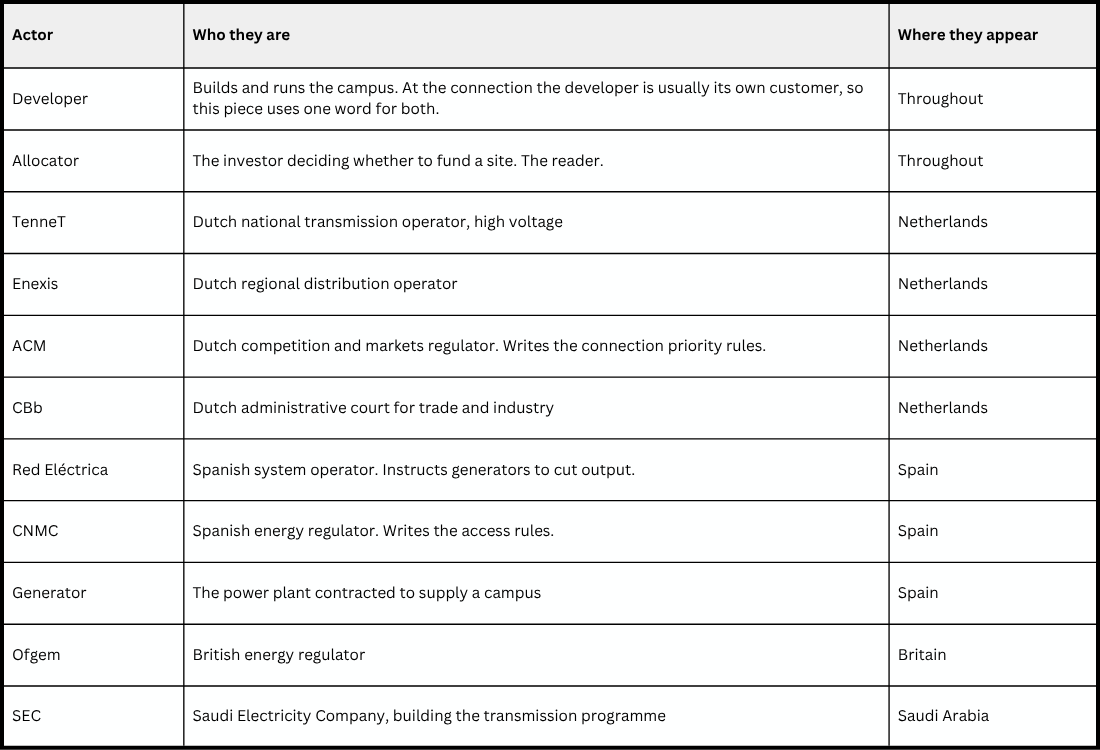
Five regulators, four grid operators and one court appear in what follows.
A developer builds a data centre faster than a utility builds the wire that feeds it. The two clocks do not meet. The International Energy Agency set out typical development times in its Electricity 2026 report.
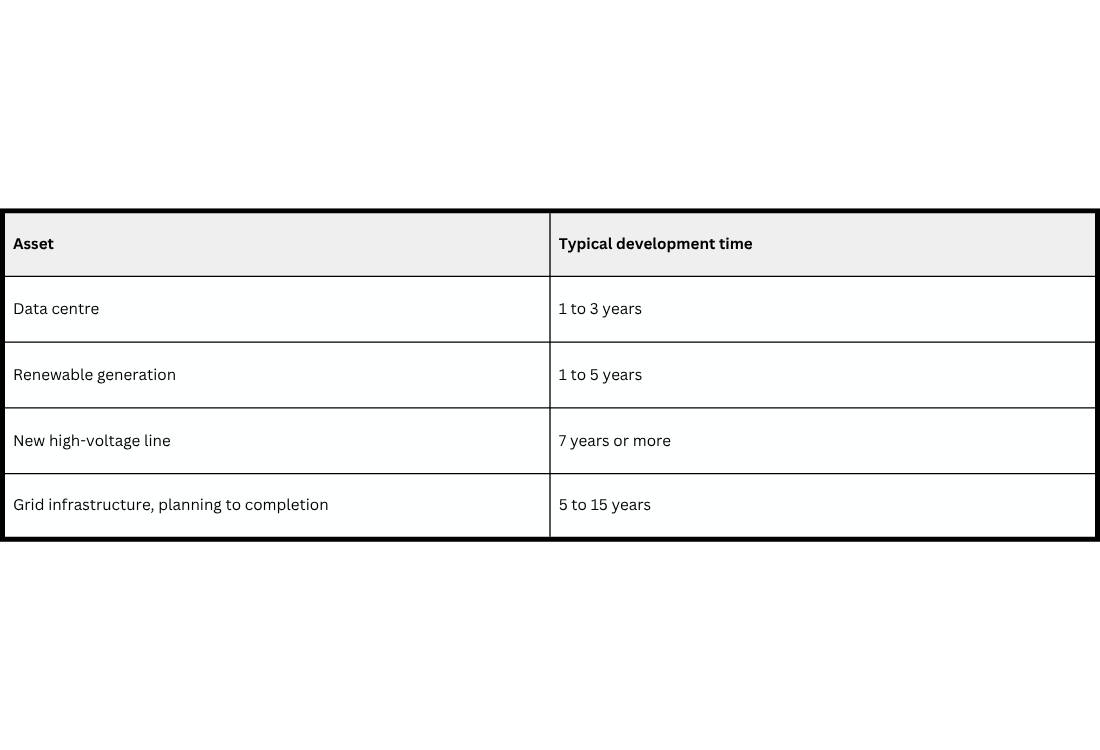
Source: IEA, Electricity 2026.
A developer can still assemble land, capital and equipment inside three years. That developer then waits on a transmission decision a utility made, or declined to make, a decade earlier. Capital does not compress that second timeline. An allocator who underwrites a European site is pricing a utility's old planning choices as much as a developer's current work.
Two European regulators count capacity sought against capacity used. They count at different stages. Minister Sophie Hermans gave the Dutch figures to parliament on 4 February 2026. She counted 212 offtake requests sitting with TenneT, and a further 14,044 sitting with the regional operators. Ofgem, the British energy regulator, published the British count on 29 July 2026.
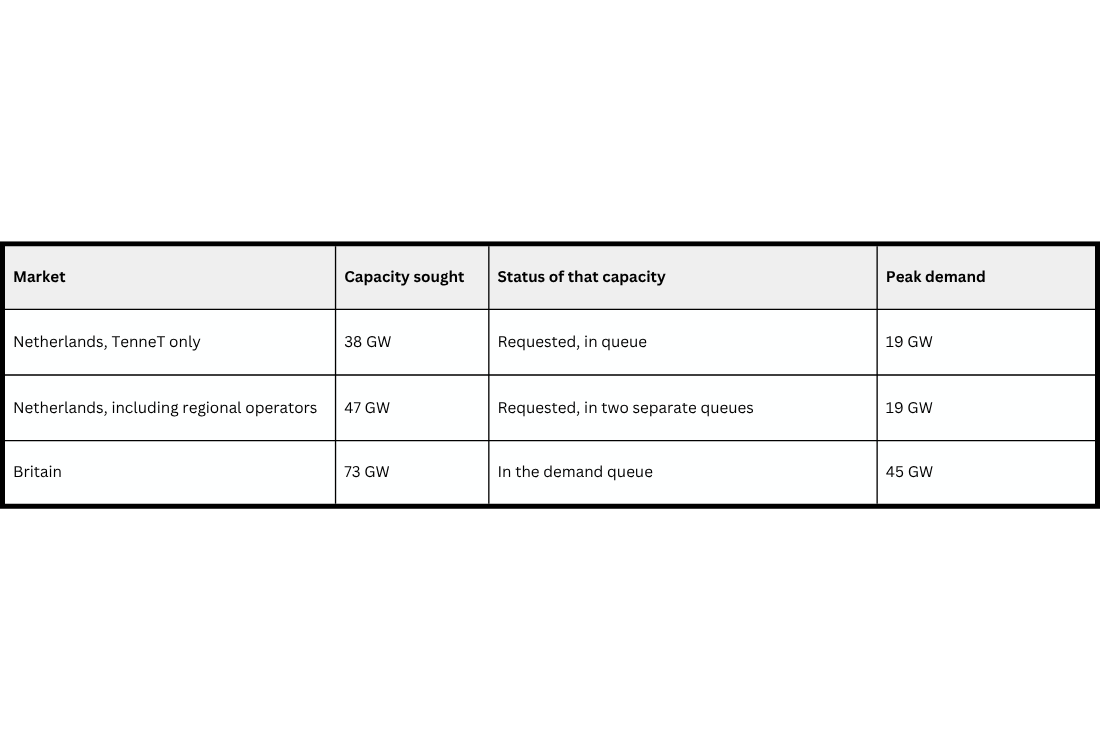
Sources: Kamerbrief of 4 February 2026; Ofgem, "Ofgem acts to free up grid capacity by tackling speculative data centre projects," 29 July 2026.
Ofgem counted data centre projects already sitting in the British demand queue. The Dutch numbers are requests still waiting on a decision. The two counts therefore sit at different stages of the same process. The two Dutch queues are also separate. TenneT holds the high-voltage requests. The regional operators hold their own. Each market still found demand well beyond what its network delivers at peak. Hermans expects her measures to free 5 to 10 gigawatts of the Dutch total by 2030.
The Dutch have decided who goes first. A data centre does not qualify on what it is. The Autoriteit Consument en Markt, the Dutch competition and markets regulator, published a national prioritisation framework on 12 December 2025. The rules took effect three weeks later. Connection requests fall into three categories. Congestion relievers come first. Safety and vital functions follow. That second group covers emergency services, healthcare, drinking water and electricity infrastructure. Basic needs come third: housing, education, public transport, telecommunications and waste management. Everything outside those three waits first-come, first-served.
The ACM used three questions to decide which functions sit in the second and third categories. Would the absence of extra transport capacity create serious risks to national security, to the continuity of important public services, or to the functioning of society? Does the activity serve a large general interest in the Netherlands? Is any realistic alternative available elsewhere in the European Union? Those questions sort categories of function. They do not sort individual customers. I read the third question against a hyperscale campus a developer can put in Aragón instead. On that reading a data centre sits outside categories two and three.
Category one asks a different question. Rather than asking what a customer is, the ACM asks whether that customer frees capacity for others. Battery storage counts. Controlled scheduling of demand counts. So does any arrangement a grid operator can show releases network room. Inside category one the ACM ranks by effectiveness rather than by arrival date. Dutch grid operators also carry a duty to go looking for congestion-relieving capacity. TenneT is now calling parties already on its waiting list and inviting them to reclassify.
The ACM closed the obvious workaround. A battery installed mainly to trade price spreads does not qualify. A battery that adds a new peak of its own does not qualify either. The customer has to show the grid gains room.
Dutch operators sell that flexibility as a product. The terms are public. A large consumer on the high-voltage network can take an ATR85/15. That is a time-duration transport right. It guarantees contracted capacity for at least 85 percent of the hours in a year. TenneT may restrict the connection during the rest. Regional operators sell two further forms. Blokstroom gives transport inside agreed blocks outside peak hours. Reststroom gives transport only in hours when capacity happens to be free. The operator confirms the next day's availability a day ahead. Each product carries a lower transport tariff, because the customer holds less certainty.
Fifteen percent of a year is roughly 1,300 hours. A developer selling four-nines availability to its tenants cannot sign that window away. The flexibility then has to come from somewhere else on the site. Behind-the-meter generation can supply it. Storage can supply it. So can a workload the developer can pause. Piece 2 set out why that describes training and not inference. A Dutch connection now pays for the difference.
A separate instrument pays for the same thing directly. Under a capacity limitation contract, a customer holding at least 100 kilowatts of contracted capacity agrees to cut demand at peak. The grid operator pays a negotiated fee. Enexis began replacing that contract in May 2026 with a capacity steering contract on wider terms. These agreements run until the network expansion in the customer's area is finished. That length is set by the same transmission timeline that opened this piece.
One more fact belongs in an allocator's file. In October 2024 the ACM issued a first version of this framework. The CBb, the Dutch administrative court for trade and industry, annulled it as insufficiently reasoned. The citation is ECLI:NL:CBB:2025:145, 11 March 2025. What took effect in December 2025 is the replacement. The rule has already changed once during a period in which an investor would still be holding the asset. Piece 4 described that exposure in Britain and Germany.
Spain shows the second version of the problem. The developer holds the connection. The power still fails to arrive as modelled. Aurora Energy Research reported on 11 August 2026 that uncompensated renewable curtailment in Spain reached 2.5 terawatt-hours across the first half of 2026. That exceeds the total for all of 2024. June 2026 alone accounted for 1.2 terawatt-hours of it. El Mundo separately reported that Spanish generators lost more than 3,900 gigawatt-hours in 2025 to first-phase restrictions for want of demand. That count is a different bucket in a different year. The two figures do not sit on one line. Aurora's series is the one that tracks 2026.
A national curtailment percentage describes almost no individual site. Aurora modelled Spain node by node in a forecast published on 2 March 2026. One node in Badajoz province comes in at 22.5 percent curtailment for 2026. Another node in the same province comes in at 3.55 percent. Badajoz carries roughly a fifth of projected near-term national curtailment. Zaragoza and Cáceres sit behind it. The node a plant connects at therefore decides its exposure.
Red Eléctrica sends curtailment instructions to generators. A data centre is a load rather than a generator, so Red Eléctrica does not switch the campus off to relieve congestion. The power purchase agreement carries the loss across to the campus instead. When the generator contracted to supply that campus receives a real-time instruction to cut output, the campus keeps drawing from the grid. The contract decides who absorbs the difference.
Contract form settles that question before anyone signs. Under a pay-as-produced structure the offtaker receives whatever the plant generates and buys the shortfall on the spot market at that hour's price. Under a baseload structure the generator owes a fixed shape and covers any gap itself. A data centre draws continuously. A solar plant produces on a curve. The two sides start mismatched before a single megawatt is curtailed. Curtailment widens a difference the contract already had to price. The renewable power purchase agreement a developer signed as a hedge becomes a different instrument once the contracted plant cannot send out its own output.
Spain compensates some curtailment and leaves the rest unpaid. Generators settle energy through the technical restrictions market under Operating Procedure 3.2 and receive payment for it. Real-time output limits that never reach that settlement form the uncompensated residual. That residual is what grew across the first half of 2026. Article 6.2 of Royal Decree 413/2014 gives renewable generation priority of dispatch, subject to system security. Security overrides priority. Red Eléctrica also tightened its security criteria after the Iberian blackout of 28 April 2025.
Two documents published on 2 March 2026 sit next to each other in the public record. Amazon Web Services announced at Mobile World Congress in Barcelona that its planned investment in Aragón would reach €33.7 billion, across sites in Zaragoza, Huesca and Teruel. Aurora published its nodal forecast the same day. Zaragoza is among the three provinces carrying most of Spain's projected near-term curtailment. Neither document refers to the other. Amazon states that its Aragón facilities have matched their electricity consumption with renewable energy since 2022, and that it is developing around 100 solar and wind projects across Spain.
Spain has now begun rationing the load itself. The instrument looks familiar. On 11 August 2026 the CNMC approved flexible access permits for demand under Circular 1/2024. Under a Type-2 permit, a distribution operator may limit the flexible portion of a connection above 1 megawatt, on a planned basis or in real time. Spanish regulators have built the same product Dutch operators sell, approached from the other end. Dutch operators discount a connection in exchange for flexibility a customer offers. Spanish operators grant a connection on terms that reserve the right to take it back.
Five European markets now ration the same scarcity through five different mechanisms.
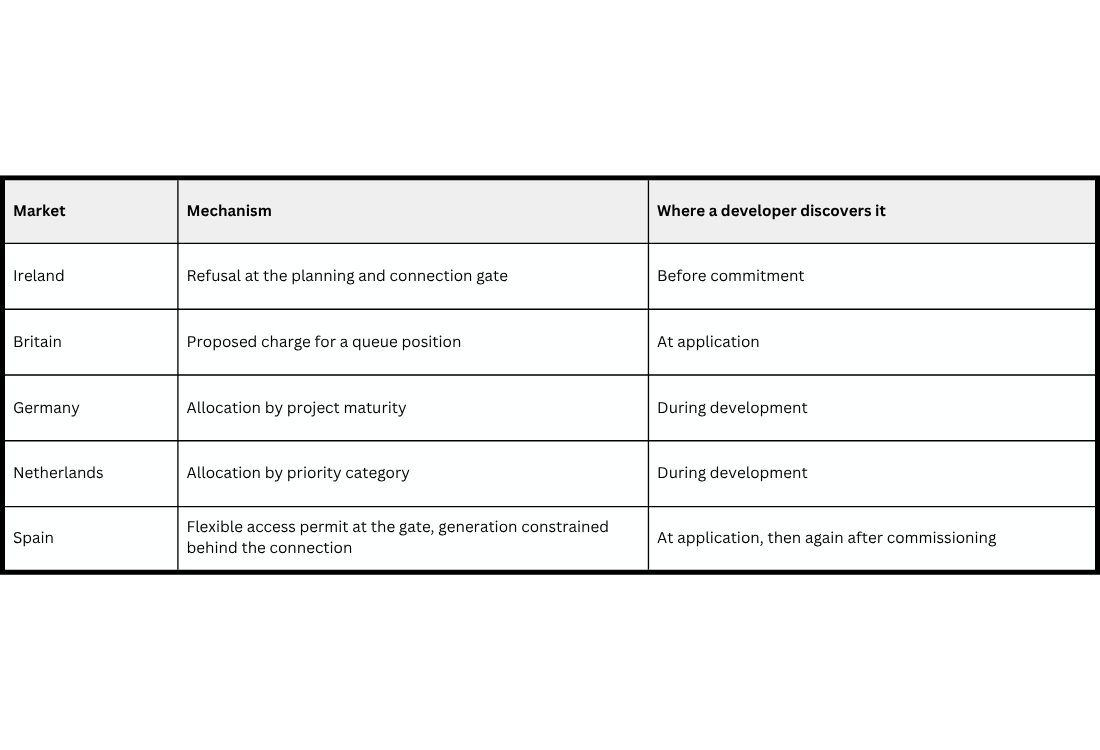
Each regulator has chosen a different moment for a developer to find out. Ireland tells a developer before it spends. Spain tells it once the campus is running. Diligence built for one of these markets will look in the wrong place in another. A model calibrated on Irish refusal risk carries no line for Spanish nodal exposure.
Two of the five have also arrived at the same answer to scarcity. The Dutch sell a cheaper connection to a customer willing to be interrupted. The Spanish sell a connection that reserves the right to interrupt. Both regulators are pricing firmness. A data centre is usually described as the least flexible load on any network.
Saudi Arabia is building the transmission that this argument requires. The Saudi Electricity Company's multi-year programme has been reported at four different envelopes, from SAR 220 billion to SAR 472 billion, depending on the source and the period counted. SEC's own reported capital expenditure came to SAR 82.2 billion in 2025. Reports put the transmission component at roughly $36 billion, covering about 14,000 kilometres of lines and 130 high-voltage substations. Four public sources therefore produce four different figures for one programme. That repeats the counting problem that produced four different figures for Saudi operational data centre capacity in Piece 2.
SEC gives urbanisation, industrial demand, renewables integration and load growth as the drivers of that programme. No SEC statement identifies data centres as the reason for the build.
Saudi Arabia does not publish a connection queue, a capacity register, or a curtailment series. Greenberg Traurig, writing in January 2026 on Saudi data centre regulation, set out the three questions investors are asking. Who bears the cost of upstream grid upgrades. How a regulator allocates priority between competing large loads. Whether curtailment relief or compensation exists at all. The Dutch prioritisation framework answers the second in a published document with a court judgment behind it. The Spanish restrictions market answers the third in a settlement rule.
Spain publishes curtailment by node. The Netherlands publishes a queue with a request count, a gigawatt total and a per-sub-grid breakdown. Saudi Arabia and the United Arab Emirates publish neither. Looking at a European site, an allocator can measure the distance between contracted generation and deliverable power before committing capital. Looking at a Gulf site, that same allocator is asking the operator to state that distance instead.
Piece 6 goes to Johor. Cheap land and state support have produced a build programme sized for a neighbour's overflow rather than for local demand.
Note for the reader: This is analysis of how these markets are structured and financed, written by someone who spends his time following how capital moves across borders and into infrastructure. It is not investment advice and not a recommendation on any asset, programme or jurisdiction.
Sources
Groningen and the Dutch grid
TenneT, "Druk op stroomnet Groningen onverminderd groot," 16 April 2025 (781 MW needed to clear the Groningen-West waiting list; 97 MW allocable in 2025; short-circuit contribution condition; reinforcement via new station at Meerstad, cable to Vierverlaten and expansion at Vierverlaten, expected in service end of 2034)
Enexis, Eemshaven congestion reappraisal, December 2025 (no congestion on feed-in; offtake blocked in part until 2033)
Kamerbrief, Minister Sophie Hermans to parliament, 4 February 2026 (212 requests with TenneT totalling 38 GW; 14,044 requests with regional operators totalling 9 GW; 5 to 10 GW expected to be freed by 2030)
The Dutch prioritisation framework
ACM, prioritisation framework (prioriteringskader), codebesluit published 12 December 2025, effective 1 January 2026, extended to small consumers 1 July 2026
ACM, criteria for congestion relievers (three tests: serious risks to national security, continuity of important public services or the functioning of society; large general interest in the Netherlands; no realistic alternative available within the EU)
College van Beroep voor het bedrijfsleven, ECLI:NL:CBB:2025:145, 11 March 2025 (annulling the October 2024 framework; ACM held to have authority but the framework insufficiently reasoned)
Dutch flexible transport products
TenneT, Tijdsduurgebonden Transportrecht (TDTR), informally ATR85/15; ACM codebesluit approval 16 July 2024 (minimum 85% of hours guaranteed; at least one day's notice for the remainder)
Enexis and regional operator product pages, Blokstroom and Reststroom
Capaciteitsbeperkingscontract, 100 kW minimum contracted capacity; Enexis capaciteitssturingscontract from May 2026
Netbeheer Nederland and operator congestion pages (duty to seek congestion-relieving capacity; waitlisted parties invited to register as congestion relievers)
Britain
Ofgem, "Ofgem acts to free up grid capacity by tackling speculative data centre projects," 29 July 2026 (315 data centre projects, approximately 73 GW of the total demand queue; GB peak demand approximately 45 GW)
Spain
Aurora Energy Research, 11 August 2026 (uncompensated renewable curtailment 2.5 TWh across first half 2026; 1.2 TWh in June 2026 alone)
Aurora Energy Research nodal forecast, 2 March 2026 (Badajoz nodes at 22.5% and 3.55% projected curtailment for 2026; Badajoz, Zaragoza and Caceres carrying most projected near-term curtailment), labelled throughout as a 2026 projection
El Mundo (more than 3,900 GWh lost in 2025 to first-phase restrictions for want of demand)
Red Electrica, Operating Procedure 3.2, technical restrictions market settlement
Royal Decree 413/2014, article 6.2 (priority of dispatch for renewable generation, subject to system security requirements)
Red Electrica security criteria tightening following the Iberian blackout of 28 April 2025
CNMC, flexible access permits for demand, 11 August 2026, under Circular 1/2024 (Type-2 permit; distribution operator may limit the flexible portion of a connection above 1 MW, planned or real-time)
Amazon Web Services announcement, Mobile World Congress Barcelona, 2 March 2026 (EUR 33.7 billion planned Aragon investment across Zaragoza, Huesca and Teruel; renewable matching since 2022; approximately 100 solar and wind projects across Spain). Neither the AWS announcement nor the Aurora forecast published the same day refers to the other, and this piece does not join them.
Development timelines
International Energy Agency, Electricity 2026, grids chapter (data centre 1 to 3 years; renewable generation 1 to 5 years; new high-voltage line 7 years or more; grid infrastructure planning to completion 5 to 15 years)
Saudi Arabia
Saudi Electricity Company multi-year transmission programme, reported at four envelopes from SAR 220 billion to SAR 472 billion depending on source and period
SEC reported capital expenditure SAR 82.2 billion, 2025
Transmission component reported at approximately USD 36 billion, approximately 14,000 km of lines and 130 high-voltage substations
SEC stated programme drivers: urbanisation, industrial demand, renewables integration, load growth. No SEC statement identifies data centres as a driver.
Greenberg Traurig, 5 January 2026, on Saudi data centre regulation (three investor questions: who bears upstream grid upgrade cost; how priority is allocated between competing large loads; whether curtailment relief or compensation exists)
Series cross-references
Piece 2 (training and inference contract structure; four figures for Saudi operational capacity)
Piece 4 (Britain and Germany; regulatory durability)
Note on the British comparison. The table describes Britain's 73 GW as sitting in the demand queue, following Ofgem's own 29 July 2026 language. Ofgem's earlier Call for Input of 13 February 2026 put data centres at approximately 50 GW on a narrower cut tied to likely ready-to-connect offers. That difference belongs in Piece 7 and is not imported here.