
Investing in Data Centres: Thinking and Capacity
European Data Centres, Read from the Gulf | Part Two of Seven
Written by Lanre Okunnuga, August 2026
Training is when a model learns. Inference is when someone uses it. Almost everything that matters in financing an AI data centre follows from that difference. Almost nothing in the announcements tells you which job a building is for.
The first piece looked at what gets sold when a data centre is financed, and how a fifteen- year lease to an investment-grade tenant differs from compute sold by the hour. This piece goes one level deeper, into the machines and the power behind them. The same split shows up there. It closes on what actually decides how much AI capacity a jurisdiction can turn out of raw electricity. That is where Saudi Arabia and the UAE are doing something distinct.
The two jobs
Training is a defined project with an end. A model is shown enormous quantities of data and works out the patterns. It runs for weeks or months, close to flat out the whole time, and then it finishes. No customer is waiting. An extra fortnight changes nothing downstream.
Inference is a service with no end. A person asks a question and the model answers, millions of times a day, at unpredictable hours, with someone waiting for the response. Two seconds is fine. Thirty seconds and the customer leaves.
The same silicon runs both jobs today. NVIDIA’s GB300 NVL72 is a rack-scale system with 72 Blackwell Ultra GPUs. NVIDIA markets it for training and for inference. A fully loaded rack draws in the 120 to 140 kilowatt range under sustained load, with peaks higher still. That convergence is starting to narrow. NVIDIA’s Rubin CPX, due at the end of 2026, is a GPU built specifically for one phase of inference rather than for training. What follows describes today’s deployed generation. It may not hold for the next one.
Anyone financing a building wants two answers from the tenant: how long they need the capacity, and what it costs them if it stops working.
Training answers: I need a very large amount of power for a defined period, and then I am finished. That is a capacity reservation. It reads like a fixed-term lease.
Inference answers: I need power available every second, indefinitely, and an outage costs me customers at once. That is an availability commitment. It reads like a running subscription.
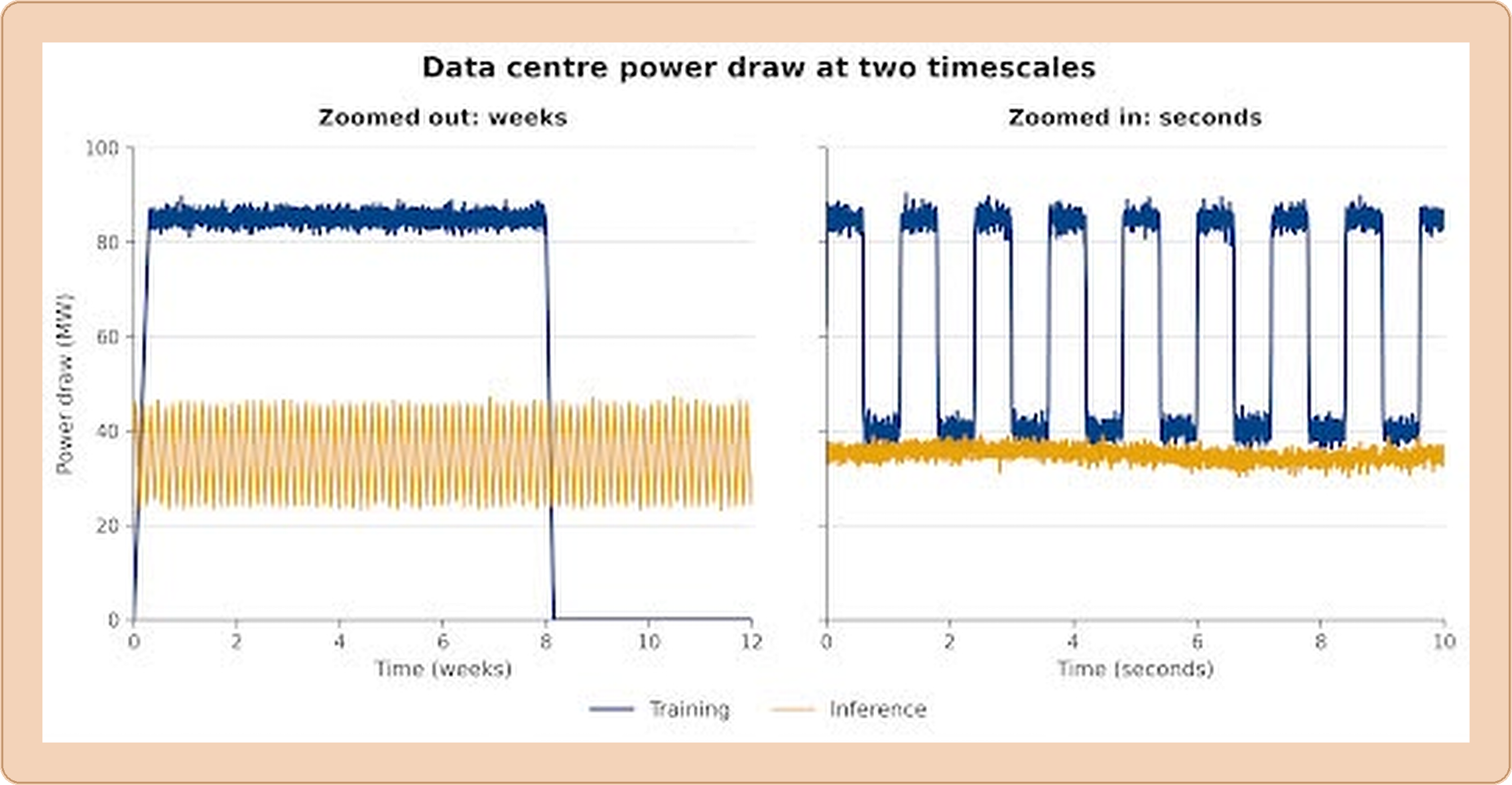
Figure 1. Power drawn by one campus. At the scale of weeks, training runs flat and near- peak, then stops. At the scale of a second, the same load swings by tens of megawatts. Inference runs continuously at a smaller, statistically smoother draw. Illustrative profile.
The load looks flat only from a distance
Training looks flat only from a distance. At the scale of a full run, the load is steady and near-peak for weeks, then off. At the scale of a single second it looks nothing like that. Thousands of GPUs move in and out of computation together. The whole cluster’s draw can swing by tens of megawatts inside a fraction of a second. That is hard enough to strain transformers and disturb grid frequency. NVIDIA builds capacitor-based power smoothing into the GB300 rack to absorb these swings before they reach the building’s electrical system.
Inference has the opposite texture. Millions of independent requests average into a load that is smaller per rack and smoother second to second, even though it never fully switches off.
Grid-forming battery storage earns its keep against both textures. It absorbs the short-term swings a training campus throws off, and it covers the steady, always-on draw an inference campus needs. It is not only an inference-side technology.
Who owns the box
Everything so far assumes an answer to a question this piece has not yet asked: who owns the accelerators.
In the colocation model that has dominated most hyperscaler deals, the tenant buys and owns its own GPUs. It rents only the shell, the power and the cooling from the operator. Under that structure the landlord’s asset barely ages. Walls, chillers and switchgear depreciate on a real-estate timeline, regardless of which chip generation sits in the racks. The renewal exposure described below never reaches the landlord. The tenant absorbs its own obsolescence risk and buys the next generation when it wants one.
In the GPU-cloud and neocloud model, and in the financing platforms now taking shape, the operator or its financier owns the accelerators. It leases compute to the workload and carries the obsolescence risk that comes with the hardware. NVIDIA’s programme, announced on 10 August 2026 with Apollo, BlackRock, Blackstone, Brookfield, Goldman Sachs and KKR, is built on exactly this structure. Special purpose vehicles are intended to
buy the GPUs and finance their deployment to NVIDIA’s customers. NVIDIA has said it may provide residual-value support for up to 25% of a deal. That backstop only makes sense as insurance against the renewal risk this piece describes. The arrangements remain memoranda of understanding rather than committed capital. The residual-value mechanic drew enough scrutiny that NVIDIA’s chief executive spent the following days explaining it publicly. Treat the structure as directional rather than settled.
The training-versus-inference distinction that follows matters most where chip ownership already sits with the operator or its financing vehicle. Where the tenant owns its own hardware, a good deal of the exposure this piece assigns to training reservations never reaches whoever holds the real estate.
Why the shape carries more weight than the megawatts
Where the operator or its financing vehicle holds the hardware, the physical plant differs before the contract does.
A building engineered for training is built around sustained near-peak draw and violent short-interval transients. The engineering emphasis falls on power smoothing, robust transformers and battery buffering for the swings.
A building carrying inference load absorbs a jagged demand curve across hours rather than seconds: quiet at three in the morning, saturated at midday. The emphasis falls on ramp capability and firm delivery over a longer clock.
Not every Gulf battery project was built with AI load in mind. The distinction matters. Saudi Arabia’s 7.8 GWh connected battery portfolio was procured by the state utility as a grid- wide stability asset. It provides black-start capability, virtual inertia and frequency response across the transmission network. Abu Dhabi’s Masdar and EWEC project pairs 5.2 GW of solar with 19 GWh of storage to deliver roughly 1 GW of continuous power. Its own developers frame it explicitly around AI and data-centre demand. Both matter to an operator sizing power. Only one was built for this specific load.
Where the operator holds the hardware, the contract consequence follows from the workload.
A training reservation is typically priced against a named hardware generation’s benchmarked throughput over a defined term. The operator’s exposure tends to appear at renewal, when capacity built around aging silicon has to be re-contracted into a market whose next training customer wants the newest cost-per-FLOP.
An inference contract is typically priced against a service outcome: latency, availability, throughput. That structure can let an operator refresh hardware across or between tenancies without renegotiating, because the tenant was never buying a specific accelerator.
The distinction cuts both ways. Training reservations of the kind described in the first piece run fifteen years, take-or-pay, with fixed escalators. That is close to the most regular payment stream an infrastructure asset can produce. Inference revenue sold on consumption can be irregular. It rises and falls with usage. It can stop and restart with no contractual floor. Training trades terminal flexibility for payment regularity inside the term. Inference trades payment regularity for the ability to keep earning past any single hardware cycle. Neither is safer in the abstract.
What follows is a reading of how these two workload types behave in principle. It is not a survey of executed contracts. The underlying agreements have not been reviewed here. Drafting varies by operator, jurisdiction and counterparty. Treat it as what to look for on a first pass.
On that basis, debt priced against a training reservation carries a coupon backed by an obligation with a stated term. That tends toward regularity inside the term and concentrates the exposure at maturity. Debt priced against inference load does not carry an equivalent fixed end date in the workload itself. Whether the contract imposes one, and whether the revenue is committed or consumption-based, is a drafting question.
The same caution applies on the equity side. A training-anchored asset’s distribution capacity may reset when the reservation is renegotiated. An inference-anchored asset may distribute through a hardware refresh, or see distributions move with usage.
The practical questions follow from that. Is the revenue committed or consumption-based. Is there a floor. What is the term, and what happens at the end of it. Is the pricing indexed to named hardware or to a service outcome. Is the counterparty one tenant or several. Those answers vary by jurisdiction and by operator. A data centre in Riyadh, Dublin or Johor will not necessarily answer them the same way.
What the global figure does and does not say
Gartner’s 2026 figures cover rented AI-optimised infrastructure only. They do not include the much larger hyperscaler self-build spend sitting alongside it. Worldwide AI-optimised infrastructure-as-a-service spending reaches roughly $42 billion this year. Inference accounts for about $23.3 billion against $19 billion for training. Inference takes 55% of the total and is forecast to reach 59% in 2027.
No Gulf-specific breakdown is published. There is a reason the regional mix might currently run the other way. Saudi and UAE capacity is being built to attract external, training-hungry anchor tenants. Domestic inference demand remains real and underserved on the Cisco survey evidence cited in the first piece. A market building for export in its early phase can be training-weighted while the global number tips toward inference.
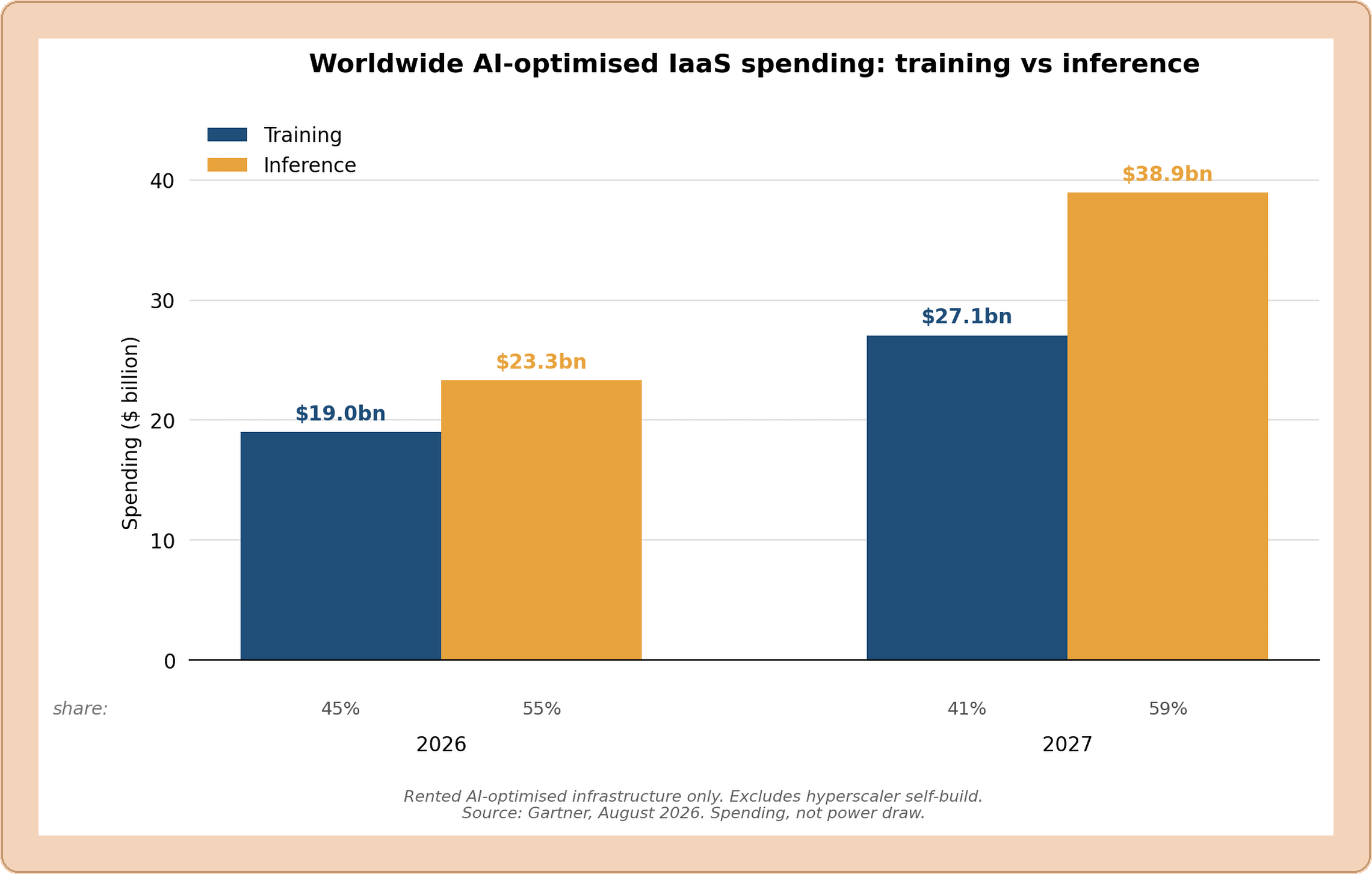
Figure 2. Spending, not power. Rented AI-optimised infrastructure only, worldwide. Excludes hyperscaler self-build. Source: Gartner, August 2026. No Gulf-specific breakdown published.
Gartner counts money, not megawatts. That distinction is easy to lose between the two charts on this page, and losing it leads somewhere wrong. The first chart shows a training campus pulling more power than an inference campus. The second shows renters spending more on inference than on training. Both are true at once, because they measure different things. One is electricity drawn by a building. The other is cash paid for capacity.
Nobody publishes a global split of how much electricity goes to each job, and this piece is not offering one. What Gartner’s figures do show is where the buying is going. Where the electrons are going is a separate question, and the honest answer is that it is not public.
Gartner’s own explanation for the buying shift is specific rather than generic. The rise of agentic AI amplifies compute intensity through multistep, autonomous execution, and Gartner names that directly as what is making inference the dominant way capacity gets purchased. Inference covers two very different things doing that consuming: a person typing a question, and an agent working through a task on its own. That distinction, covered next, is the mechanism behind the number just cited, not a side note to it.
What the job costs once agents do it
The European series looked at inference used by an agent completing a task rather than a person typing a question. An agent runs through several kinds of thinking inside a single request: planning, calling other systems, running in the background, holding what it already knows, and coordinating with other agents.
Gartner puts agentic tasks at five to thirty times the cost of a normal query. Some analysts extend that further for multi-agent coordination, into a twenty-to-fifty-times range. That higher figure is an extrapolation rather than a distinct Gartner data point and deserves more caution. Either way, none of this is smarter thinking. It is only more of it, stacked into one request.
Coordination is mostly a data-movement problem rather than a computation problem. Agents handing work between chips spend their cost shifting information. The electrical connections doing that shifting are approaching their own power limits. The industry answer is co-packaged optics: moving the optical engine onto the switch package so data leaves as light much earlier. Meta and Broadcom measured an 800G pluggable transceiver at around 15 watts against roughly 5.4 watts for the co-packaged version, in testing presented at ECOC 2025.
No Gulf facility has publicly disclosed co-packaged optics as a deployed component. It would be wrong to suggest otherwise. The point is directional. The next constraint on how
much AI compute a megawatt can produce may sit inside the building rather than at the grid connection.
The real competition is speed to firm power
The Gulf story is usually told as cheap electricity. That version is true and shallow.
Every jurisdiction building AI infrastructure faces the same sequence. Get grid capacity, or build generation. Firm the power so it is available when the load needs it. Deliver it at high density to the rack. Cool it. Move data between chips efficiently. Each stage decides how much useful compute comes out of each megawatt.
Contract duration lengthens the closer an asset sits to the underlying electricity. That pattern is showing up across jurisdictions. Chevron and Microsoft signed a twenty-year power purchase agreement for a planned 2.67 GW co-located gas project in West Texas, Project Kilby, with first power targeted for 2028. Chevron’s board has not yet reached final investment decision, expected by the end of 2026. Large Saudi battery projects are typically procured under long-term utility offtake arrangements. Fifteen-year terms are consistent with regional practice, though a public document confirming that exact term for the current wave was not located for this piece.
Those durations, where confirmed, run longer than most compute contracts and considerably longer than a training cycle. The infrastructure underneath the compute is being financed on utility timelines while the compute itself is sold on much shorter ones.
The United States is solving the power-timing problem from the other direction. Behind-the- meter generation now features in a substantial share of planned US capacity, overwhelmingly gas. xAI’s Memphis facility used on-site turbines to begin operating while grid infrastructure was developed. Amazon is pursuing multi-gigawatt on-site generation in Texas. Estimates of the premium vary by study. RaboResearch puts behind-the-meter combined-cycle gas at roughly $101 per megawatt-hour against a national average industrial grid rate near $86 at the five-year mark. Lazard’s 2026 series puts combined- cycle gas LCOE at $90 per megawatt-hour, up from $78 the year before, as data-centre demand pulls on the same turbines everyone else needs.
On-site generation’s real advantage is time rather than price. It comes online before a grid connection would. In AI infrastructure that head start matters more than the marginal difference in the cost of electrons.
On queues, more precisely
I described Europe in the first piece as having a connection queue and the Gulf as having none. The first half needs updating. Britain’s queue has already been reformed. It had grown past 700 GW before the National Energy System Operator re-ordered the entire pipeline in
December 2025. The retained development queue was cut to 238 GW. Roughly 13 GW of firm demand is clearing to connect before 2030, with a further 86 GW slated for 2030 to 2035, much of it hyperscale data-centre and industrial load. That remains a genuine capacity-rationing mechanism, and it is still the binding constraint the European series kept finding in every country.
Saudi Arabia has a formal connection process too. The Saudi Arabian Grid Code contains a Connection Code governing new transmission connections: applications, network impact studies, connection offers and commissioning. Large loads frequently require developer- built or co-funded substations. The regulation also contemplates captive generation by a transmission-connected customer. That gives a developer a third option beyond waiting or abandoning.
The real difference from Europe is the mechanism. Saudi capacity planning sits centrally with the regulator and the utility ahead of demand. European capacity was rationed among speculative applications arriving faster than the grid could sensibly evaluate them. The precise elapsed time for a Saudi connection is not published in a way that supports an exact comparison. That gap in disclosure tells a Gulf readership something on its own.
That distinction identifies what is actually being sold. A jurisdiction competing on a centrally planned connection process is selling certainty about when a building can operate, even where it has not published the number of months that certainty represents. That is a different product from cheap electricity, and it is considerably harder for a competitor to replicate.
What this leaves open
Public disclosures do not provide a training-versus-inference split for Saudi or UAE capacity. The major announcements describe infrastructure supporting both. HUMAIN and NVIDIA announced AI factories reaching up to 500 MW with several hundred thousand GPUs over five years, beginning with an 18,000-GPU deployment. AWS and HUMAIN described the Riyadh AI Zone as supporting training and inference alike.
That is commercially sensible rather than evasive. A flexible AI factory hedges against accelerator obsolescence in a way a dedicated training cluster does not. The honest question is not what the Gulf is building, which is broadly known. It is what proportion of it eventually carries high-utilisation, continuously contracted inference load.
That proportion decides whether these assets behave like factories or like utilities. It is not knowable yet from anything published. Neither is a second question that matters just as much to whoever is pricing the debt: whether the accelerators inside these facilities sit on the tenant’s balance sheet or the operator’s. Public announcements in Saudi Arabia and the UAE are silent on that point too.
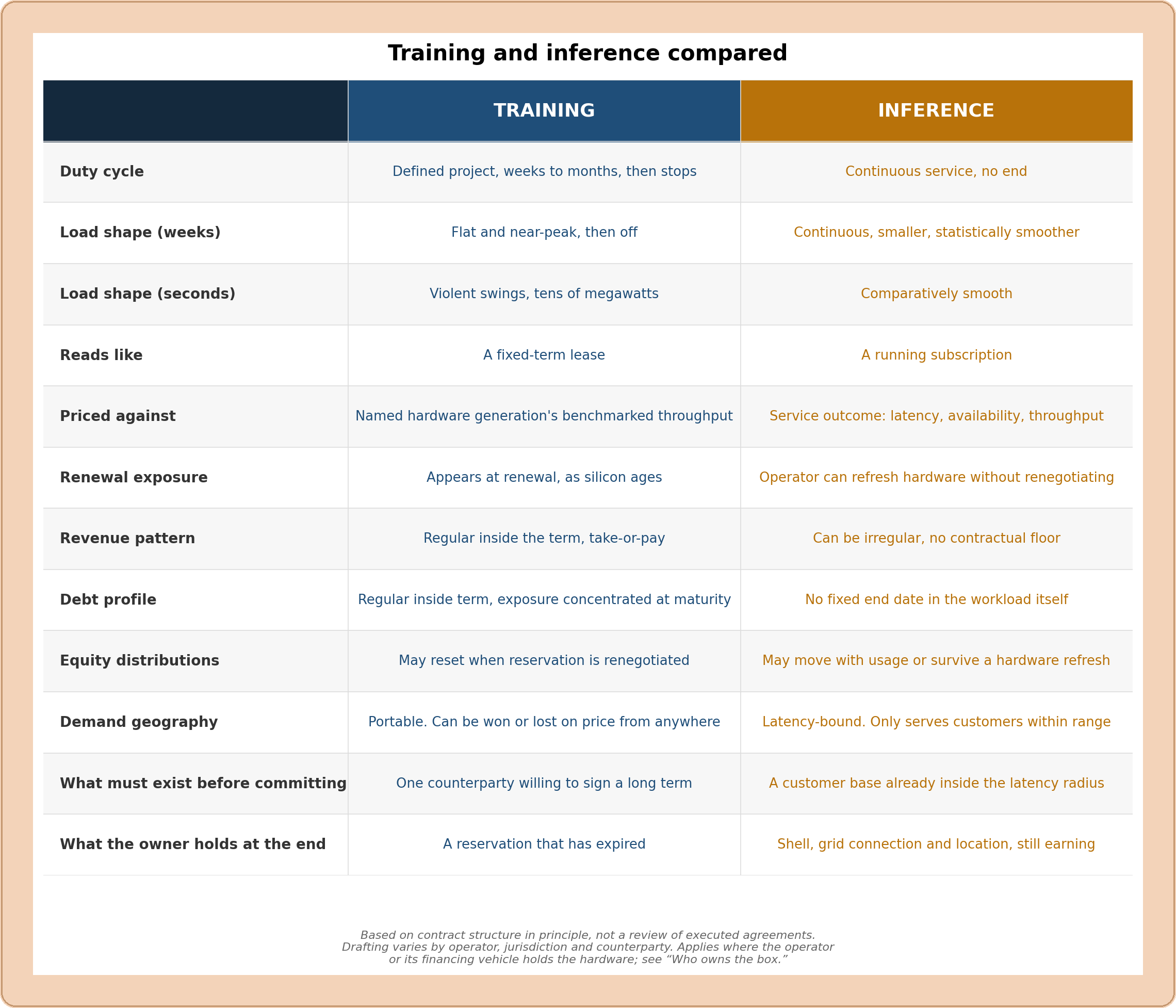
Figure 3. Based on contract structure in principle, not a review of executed agreements. Drafting varies by operator, jurisdiction and counterparty.
Next Article: What happens when the answer is not slow but no, and what a grid refusal actually costs on a live project.
Note for the reader:
This is analysis of how these markets are structured and financed, written by someone who spends his time following how capital moves across borders and into infrastructure. It is not investment advice and not a recommendation on any asset, programme or jurisdiction.