
Is the U.S. Still the Default? How GCC Investors Are Rethinking Global Allocation
For decades, the United States has not merely been a core market; it has functioned as the default destination for institutional capital. The decision was historically straightforward, driven by depth, liquidity, and a private-markets ecosystem. This dominance is reinforced by the role of the dollar, which extends far beyond reserve holdings and into the very plumbing of the global financial system; it underpins everything from cross-border lending to trade invoicing.
The numbers tell a story of singular gravity. Roughly 90% of global transactions involve the dollar in some form, which far exceeds America’s share of global output (Capital Economics, 2025). For investors in the Gulf, this has long dictated a simple, enduring strategy: overweight the U.S. and diversify cautiously from the margins. While that logic is now being questioned, it is far from being abandoned.
The Structural Grip of the Status Quo
Among investors actively seeking diversification, there is a clear recognition that the U.S. remains difficult to avoid.
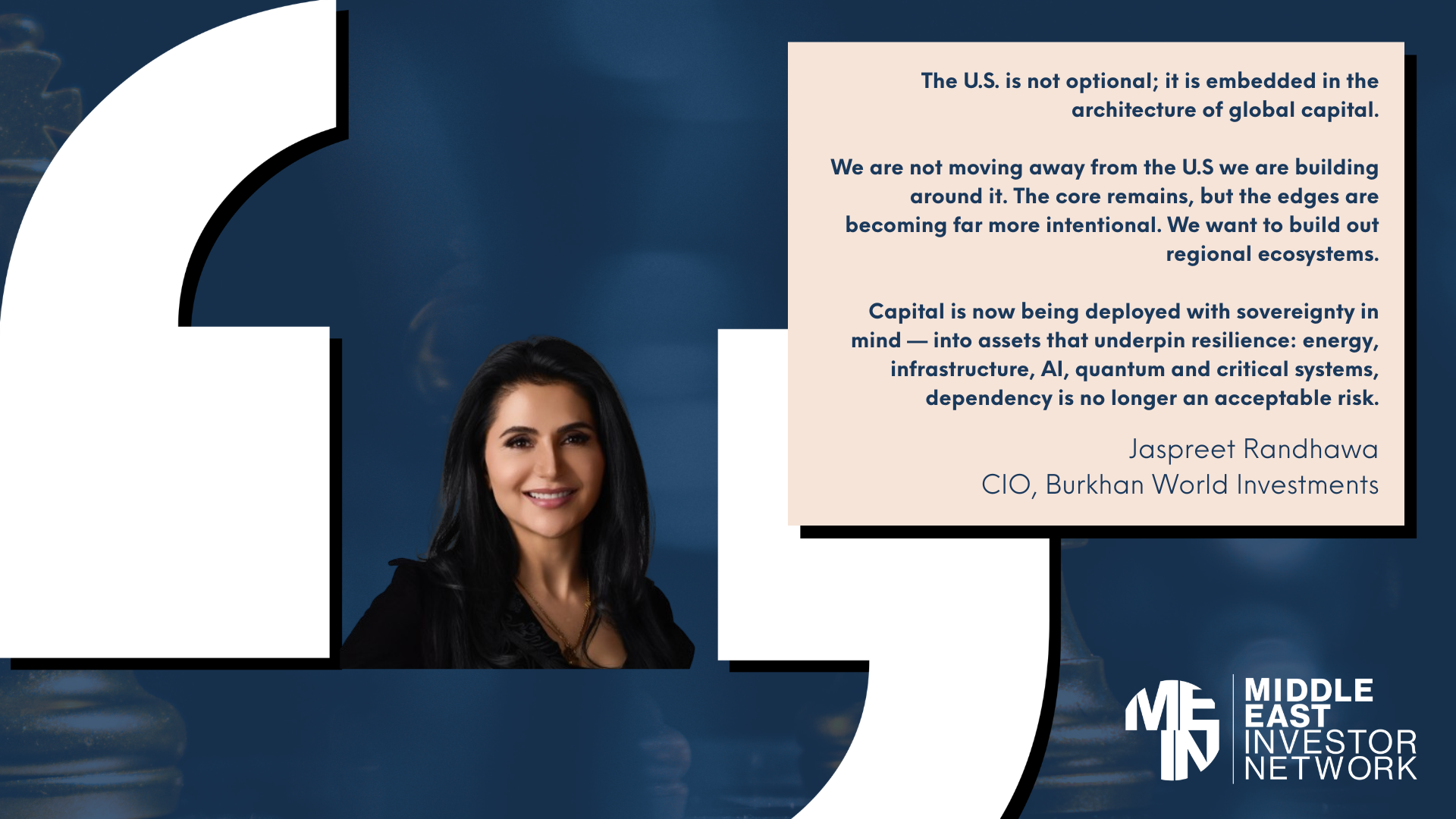
"The U.S. is not optional; it is embedded in the architecture of global capital" says Jaspreet Randhawa, Head of Investments at Burkhan World Investments.
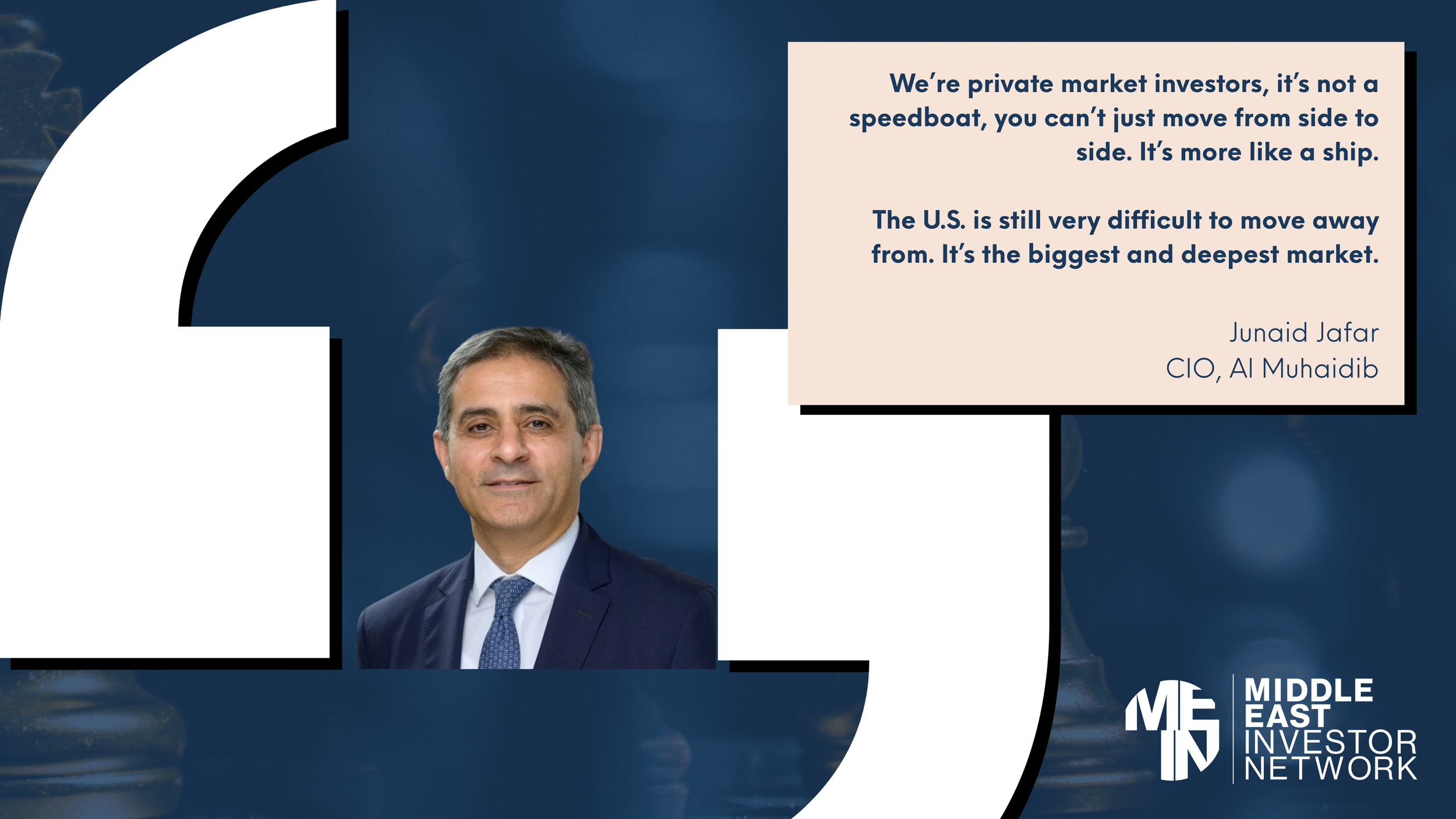
The U.S. is not dominant because it is universally loved; it is dominant because it is structurally very hard to replace. “The U.S. is still very difficult to move away from,” adds Junaid Jafar, CIO at Al Muhaidib. “It’s the biggest and deepest market.” Historically, Al Muhaidib have allocated close to 70% of their capital into dollar-denominated assets. “It was a no-brainer,” Jafar says.
The reality is that even when the desire to change exists, the mechanics of private markets act as a brake. “We’re private market investors,” Jafar explains; “it’s not a speedboat, you can’t just move from side to side. It’s more like a ship.”
These portfolios are built over years, meaning one cannot simply decide to be 30% less exposed overnight. Jafar expects any shift to be gradual, perhaps moving from 70% to the low-mid 60s over time. Beyond the structural ties, currency remains a primary friction. “If you go into euros, for example, and the currency moves against you, that matters,” he notes. For now, the system continues to favour the incumbent.
A New Map: Sovereignty and Parallel Ecosystems
While the core remains intact, the global allocation strategy is beginning to shift. Across the Gulf, investors are not necessarily rotating away from the U.S., but they are certainly expanding beyond it. The change is subtle but significant; rather than treating global allocation as a U.S. centric model with marginal diversification, many are now building parallel exposures, particularly in their own regions.
“We are not moving away from the U.S” Jaspreet says “we are building around it. The core remains, but the edges are becoming far more intentional. We want to build out regional ecosystems.” This marks a mindset shift from "U.S. first, everything else second" to a model where the U.S. is the core while real exposure is built elsewhere in parallel. In the Gulf, that "elsewhere" increasingly means at home.
This next era of investment is defined by one word: sovereignty. Capital that once flowed outward is being redirected into sectors tied to long-term economic resilience. “Capital is now being deployed with sovereignty in mind — into assets that underpin resilience: energy, infrastructure, AI, quantum and critical systems,” Jaspreet adds. “Dependency is no longer an acceptable risk.”
This marks a departure from the previous decade, when capital was oriented toward financial assets and software. Today, the rapid expansion of AI has exposed structural constraints in energy and data infrastructure. In many cases, the constraint is no longer innovation, but capacity. Consequently, capital is flowing toward "un-glamorous" assets like power generation and industrial systems. “In our region, we actually have an advantage,” Jafar adds, citing power accessibility and the ability to operate data infrastructure.
The Asian Corridor and the "Dual-Hub" Network
If one zooms out, Asia appears as the most logical destination for diversification. “It’s the second largest economy; it should be a core allocation,” Jafar says regarding China. Yet, access remains uneven. Private markets rely heavily on physical proximity and relationships. “Private markets are all about touch points,” he explains; “without a physical presence, it’s harder.”
However, the operational landscape is maturing. Bhavik Vashi, Managing Director for Asia Pacific, Middle East and Africa at Carta, points to a renewed acceleration in key markets. “One of the markets we are most focused on right now is Hong Kong,” he says. “It manages a private markets ecosystem of over $240 billion, and its return as a leading IPO venue has reintroduced a meaningful source of liquidity and renewed confidence among investors.”
Together with Singapore, Hong Kong is forming what Vashi describes as a “dual-hub network” anchoring capital flows across Asia. This corridor is increasingly acting as a conduit for institutional private capital, connecting global investors with Southeast Asian opportunities in B2B software, fintech, and logistics. This is further supported by the evolution of fund structures like Singapore’s Variable Capital Company (VCC) and the Abu Dhabi Global Market (ADGM), which allow for more efficient pooling of capital across jurisdictions.
MENA: From Capital Source to Investment Destination
While Asia represents outward diversification, the Middle East itself is undergoing a more structural transformation. Saudi Arabia’s Vision 2030 has acted as a catalyst, accelerating the development of a domestic venture ecosystem; Riyadh, in particular, is emerging as a technology hub, supported by institutions such as Saudi Venture Capital Company and Monsha’at.
At the same time, Dubai and Abu Dhabi continue to position themselves as regional and global platforms for capital and talent. Regulatory frameworks such as the DIFC and ADGM offer common-law environments familiar to international investors, which reduces friction for cross-border activity. Across Africa, the picture is more uneven, though markets such as Nigeria, Kenya, and Egypt have established venture ecosystems. While funding levels have moderated since the peak of 2021–2022, key sectors like fintech continue to show resilience with an emphasis on sustainable unit economics. Across both regions, a common theme is emerging; “founders are increasingly building for regional scale from day one,” Vashi notes.
The Liquidity Moat: Why Exits Still Lead to America
Despite the growth in regional ecosystems, a key distinction remains: the exit. “The U.S. remains the deepest and most established exit market globally,” Vashi says, pointing to the consistency of liquidity across public markets and M&A activity. In contrast, Asia’s exit landscape remains more cyclical and less predictable.
“Companies are staying private for longer, IPO windows can be cyclical, and M&A activity has become more selective,” Vashi adds. This has led to the rise of secondary markets, which have evolved from opportunistic tools into structural components of private markets. While Hong Kong’s revival as an IPO venue is restoring a credible regional pathway, the implication for investors is that exit optionality matters as much as the entry strategy. “The most resilient managers are building portfolios with multiple pathways; whether through local listings, cross-border IPOs, M&A, or secondary transactions,” says Vashi.
The System is Changing, Not Breaking.
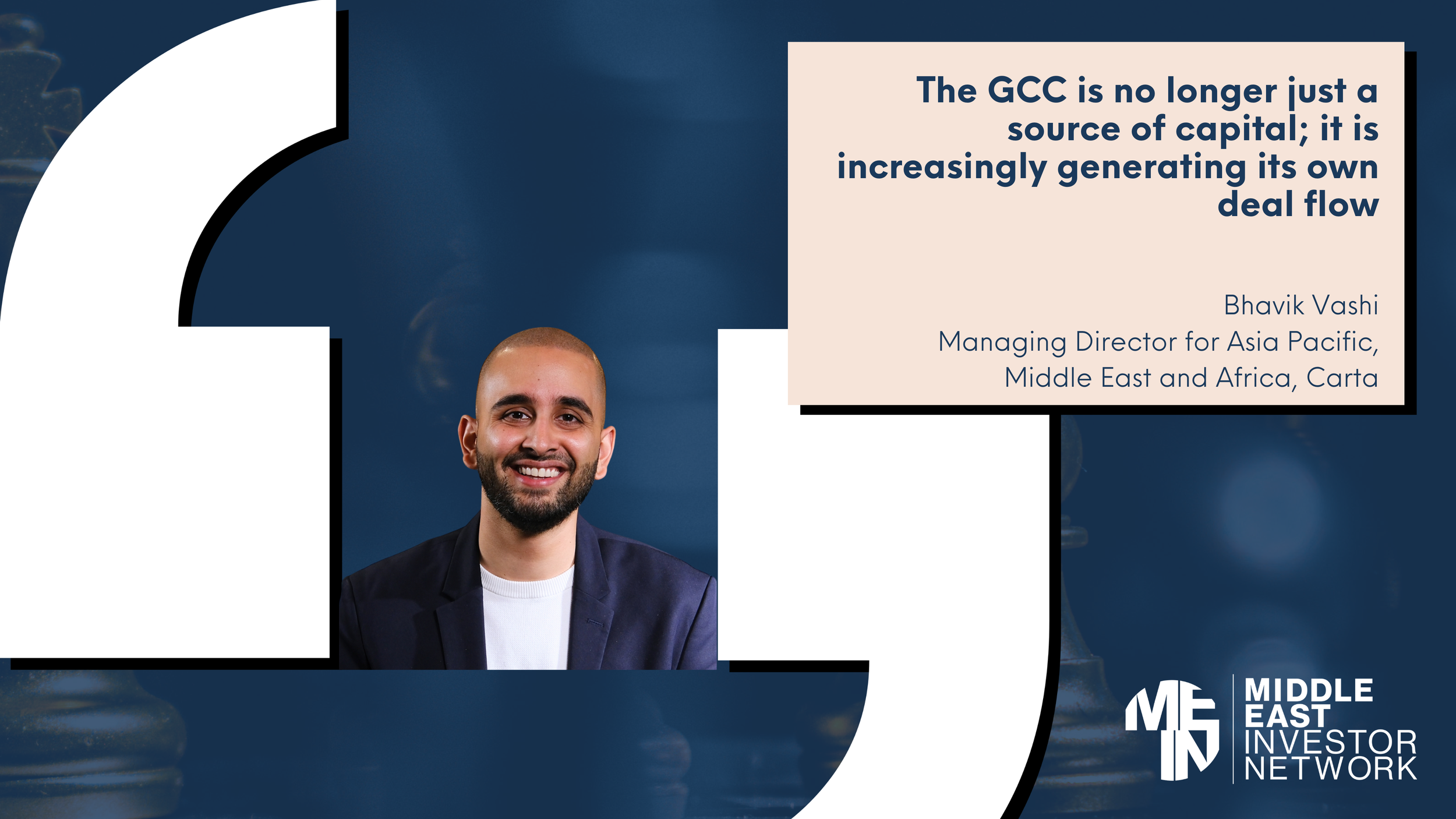
Ultimately, for the Gulf, the transformation is structural. “The GCC is no longer just a source of capital; it is increasingly generating its own deal flow,” Vashi notes. From Saudi Arabia’s Vision 2030 to the regulatory frameworks of the DIFC and ADGM, the region is becoming an investible destination in its own right.
Yet, for all the talk of "de-dollarisation," few investors believe a true alternative to the U.S. is emerging. The dollar’s dominance is sustained by network effects, institutional trust, and the absence of substitutes. “De-dollarisation is often overstated. The real shift is not away from the U.S., but toward building credible alternatives alongside it,” Jaspreet remarks.
The global financial system remains deeply dependent on the U.S., even as it seeks to diversify around it. What is emerging is not a post-American system, but a more layered one. The U.S. remains the core allocation, but around it, investors are building regional exposure, strategic infrastructure, and long-term domestic capacity.
“This isn’t about leaving the U.S.,” Jaspreet concludes. “It’s about acknowledging that it still anchors the global system - and building everything else around that reality.”
Written by: Rachel Zlatar, Head of LP Engagement, Middle East Investor Network